Keynote Speakers
(Speakers are listed in the order of their confirmation.)
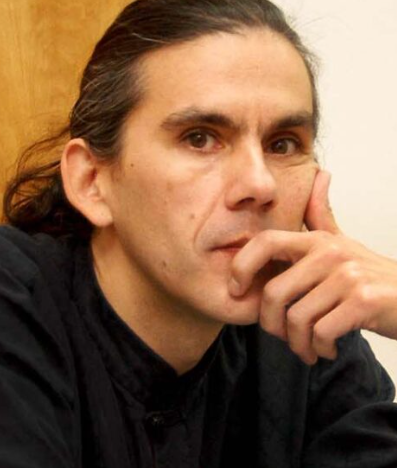
Prof. Daniel Noemi Voionmaa
Affiliation: Northeastern University, USA
Bio
Daniel Noemi Voionmaa is a cultural critic, chronicler, and scholar of
Latin American literature and culture. His research and teaching
focuses on the intersection of critical theory and literature, and
on visual arts, sports, film, and politics.
His last books are Surveillance, the Cold War and Latin American
Literature (Cambridge UP); Who is Chile? (RIL); and the edited
volume World Cup! History, Politics and Art of the Beautiful Game
(Vernon Press). Currently he is working on issues of identity,
colonialism, religion and literature in the 16th and 17th centuries
in Europe and Latin America.
He is a Professor at Northeastern University, Boston, where he
teaches literature, film, politics, football and national
identities, and contemporary Latin American cultures.
Talk Title
“Literature, National Identity, and the Beautiful Game”
Abstract
Literature has always been closely linked to the notion of national
identity—whether as "foundational fictions" (Sommers) in the case of
novels, or as the creator of an identity-based imaginary,
particularly in poetry. Literature speaks to us of who we have been,
who we are, and, above all, who we desire to become.
My presentation explores how literature—both poetry and
prose—reflects the imaginary of national identities within a
specific context: football. I examine various instances where
literature addresses football and, in doing so, functions as both
"mirror and mask" (Archetti) for our identities. I begin with the
unique trajectory of Ferenc Platko—a stateless Barcelona goalkeeper
from a century ago—who was immortalized in a poem by Rafael Alberti
and a song by Carlos Gardel. Then, I attempt to show how the
literary imagination traverses Latin American and European
identities, with a particular focus on the writings of Eduardo
Galeano.
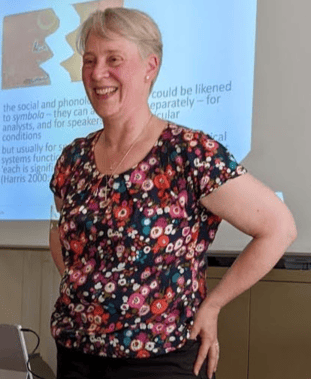
Prof. Jane Stuart-Smith
Affiliation: University of Glasgow, UK
Bio
Jane Stuart-Smith has been Professor of Phonetics and Sociolinguistics at the University of Glasgow since 2013, first joining the University in 1997 as Lecturer in English Language, where she has worked with colleagues to develop the Glasgow University Laboratory of Phonetics (GULP). With members of GULP and collaborators outwith Glasgow, she considers the many relationships between speech and society, taking the rich linguistic variation in Scotland as the basis for her work (e.g. Sounds of the City). More recently, she has been using corpus phonetic techniques to consider phonetic and phonological variation over space and time in the Englishes of the British Isles and North America (SPeech Across Dialects of English - SPADE), and is currently examining Variability in Child Speech, in a large longitudinal and cross-sectional cohort of typically-developing children in Scotland. Jane also works closely with colleagues in Scotland to promote the public understanding of phonetics by developing accessible web resources for speech and accents (e.g. Seeing Speech; Dynamic Dialects; STAR).
Talk Title
“Are we nearly there yet? Some observations from a corpus (phonetic) traveller across English”
Abstract
Language corpora enable linguists to effectively travel across
regional and social varieties of languages, as well as to track language
change over time. Previous research provides conceptual maps and
motivates research questions to act as routes with which to traverse the
actual terrain of our corpora, insofar as the tools at our disposal
allow. Until recently, analysis of large amounts of text has
substantially outstripped large speech corpus analysis, at least partly
because of the complexities of scaling up audio data processing, and
achieving robust, consistent, large-scale acoustic phonetic analyses.
In this talk, I discuss how advances in speech data processing combined
with large-scale speech corpus analytic software (PolyglotDB, McAuliffe
et al 2019), applied to the substantial SPeech Across Dialects (SPADE)
meta-corpus (Sonderegger et al 2022; Stuart-Smith et al 2024), help
begin to address the question: how well do our maps represent the
terrain they are supposed to chart? And specifically: what is 'English'
phonology really like?
Three case studies drawing on SPADE corpora over space and time, are
outlined: the English Voicing Effect (the difference in vowel duration
before obstruents signalling the voicing contrast, e.g. beat/bead;
Tanner et al 2020); the Scottish Vowel Length Rule (the
morphophonological pattern of vowel durations which distinguishes
Scottish varieties from all other Englishes; Stuart-Smith and Macdonald
2026); and /r/ in Scottish English (Lawson and Stuart-Smith
forthcoming). The findings confirm some assumptions from previous
(smaller-scale) studies but also show how our maps need to be redrawn. I
conclude by taking a detour into different linguistic terrain with a new
vehicle, and show how Automatic Speech Recognition, a key tool for
automatically processing and segmenting speech corpora, can also act as
a novel tool for corpus phonetic analysis.